What Bodyweight Is Best for Jumping? (And Should You Cut?)
The answer is relative strength, not a scale number. Here is the math that decides whether you should lose fat or build strength first.
There is no universal best weight for jumping — there is a best relative strength. Every kilogram of fat you carry is mass you must accelerate; every kilogram of strength is force you can apply.
Think in ratios, not kilograms: the same bodyweight can be an advantage or a liability depending on how much of it is force-producing muscle.
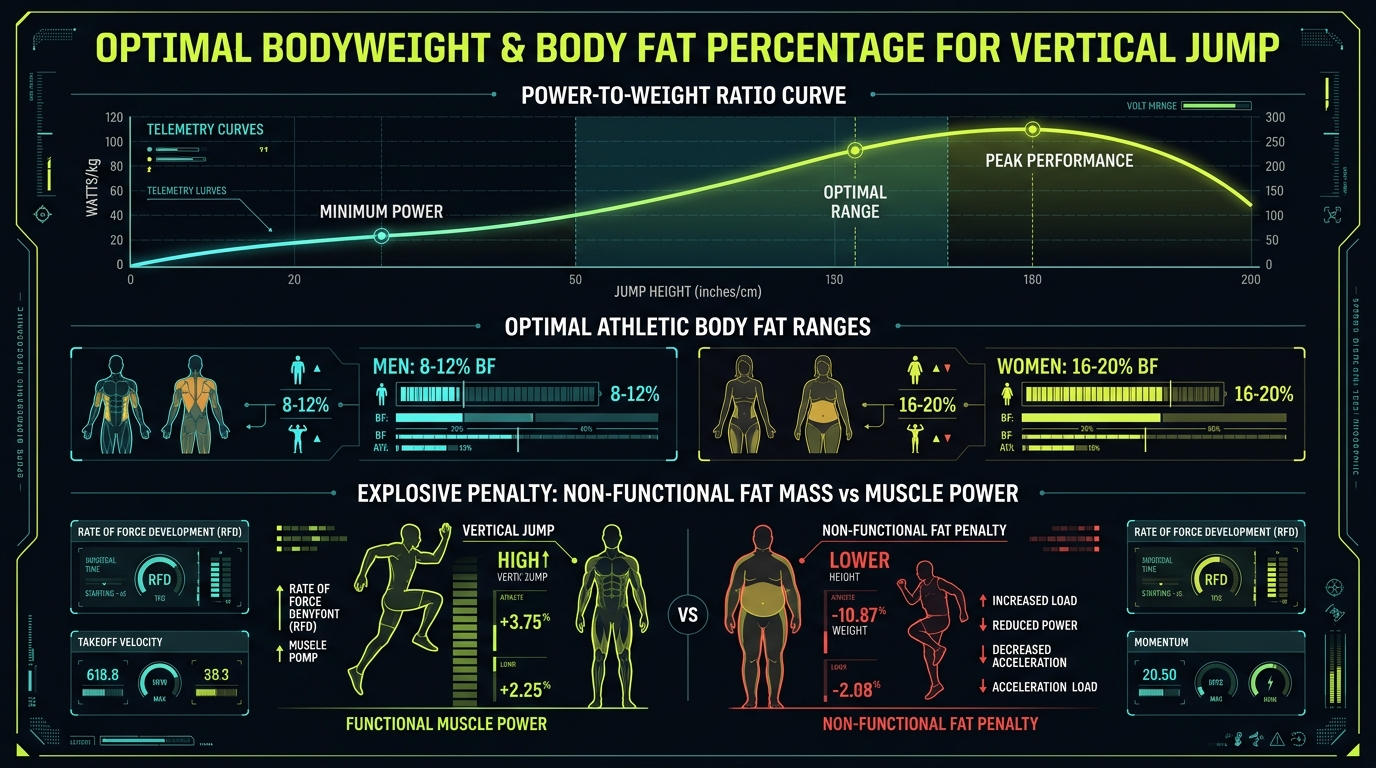
The key metric: relative strength
Relative strength is squat 1RM divided by bodyweight. Above 1.8x is excellent jump potential; below 1.2x means strength or fat loss should come first.
The fat-loss math
As a rough planning estimate, losing 1 kg of pure fat while keeping strength intact is often worth about 1–2 cm of CMJ for heavier athletes. The effect shrinks as you get leaner, and if you lose strength while cutting, jumping drops. The rule: never cut into your strength.
The decision rule
Lower bodyweight is better only while your squat stays above ~1.8x bodyweight. If your squat is only 1.2x, build strength before cutting. And ignore the BMI trap: many jump athletes have a BMI over 25 with body fat under 12%.
Relative strength as the real target
Relative strength — squat 1RM divided by bodyweight — is the number that predicts jumping. Elite-athlete data show maximal squat strength correlates strongly with vertical jump, and expressing it per kilogram removes the bodyweight confound.
A relative squat above 1.8x is excellent jump potential; below 1.2x, strength or fat loss should come first.
Cutting without losing power
When you do cut, protect the jump: keep protein at 1.6–2.2 g/kg, use a modest deficit of roughly 300–500 kcal, keep lifting intensity high while dropping volume, and monitor CMJ weekly.
If CMJ drops while the scale falls, the cut is eating strength — slow it down or stop.
The weight-loss decision flow
A simple branch for deciding what to do next:
- Squat/BW below 1.2 → build strength first; cutting now will cost jump.
- Squat/BW 1.2–1.8 → either direction works if protein and intensity are maintained.
- Squat/BW above 1.8 with high body fat → cut slowly and monitor CMJ weekly.
Key takeaways
- Relative strength, not weight, predicts jumping.
- Fat loss helps only while strength is preserved; the cm-per-kg effect varies by athlete.
- Build strength first if your squat is below 1.2x bodyweight.
- A small deficit with high protein and maintained lifting protects your jump.
- Monitor CMJ during any cut — it will tell you before the scale does.
Related calculators
References
- NSCA Essentials of Strength Training and Conditioning (4th ed.), Ch. 9
- Markovic & Jaric (2007) J Strength Cond Res
- PubMed: Maximal squat strength and vertical jump in elite soccer players
Keep reading
BODY FACTORS
How Much Do Height, Weight and Skeleton Matter for Jumping?
Training level explains 60–80% of jump performance. Height matters far less than relative strength and body composition.
BODY FACTORS
Does Age Affect Jump Training?
The training priorities change across decades — neural plasticity for youth, recovery management for masters — but it is never too late to start.
BODY FACTORS
Do Flat Feet Hurt Your Jump? Shoe Choices Explained
A flattened arch weakens the spring effect — but it is not decisive. Foot training, shoe choice and calf flexibility all matter more.