Single-Leg vs Double-Leg Jumps: Which Should You Train?
Two-leg jumps build symmetric force; one-leg jumps build horizontal-to-vertical conversion. Most athletes need both.
Standing jumps and running takeoffs are different movements that demand different qualities. Training only one leaves a gap you will feel in games.
The two jumps test different springs: double-leg jumps are a strength-and-SSC expression; single-leg running takeoffs are a conversion problem with a shorter contact.
The biomechanical difference
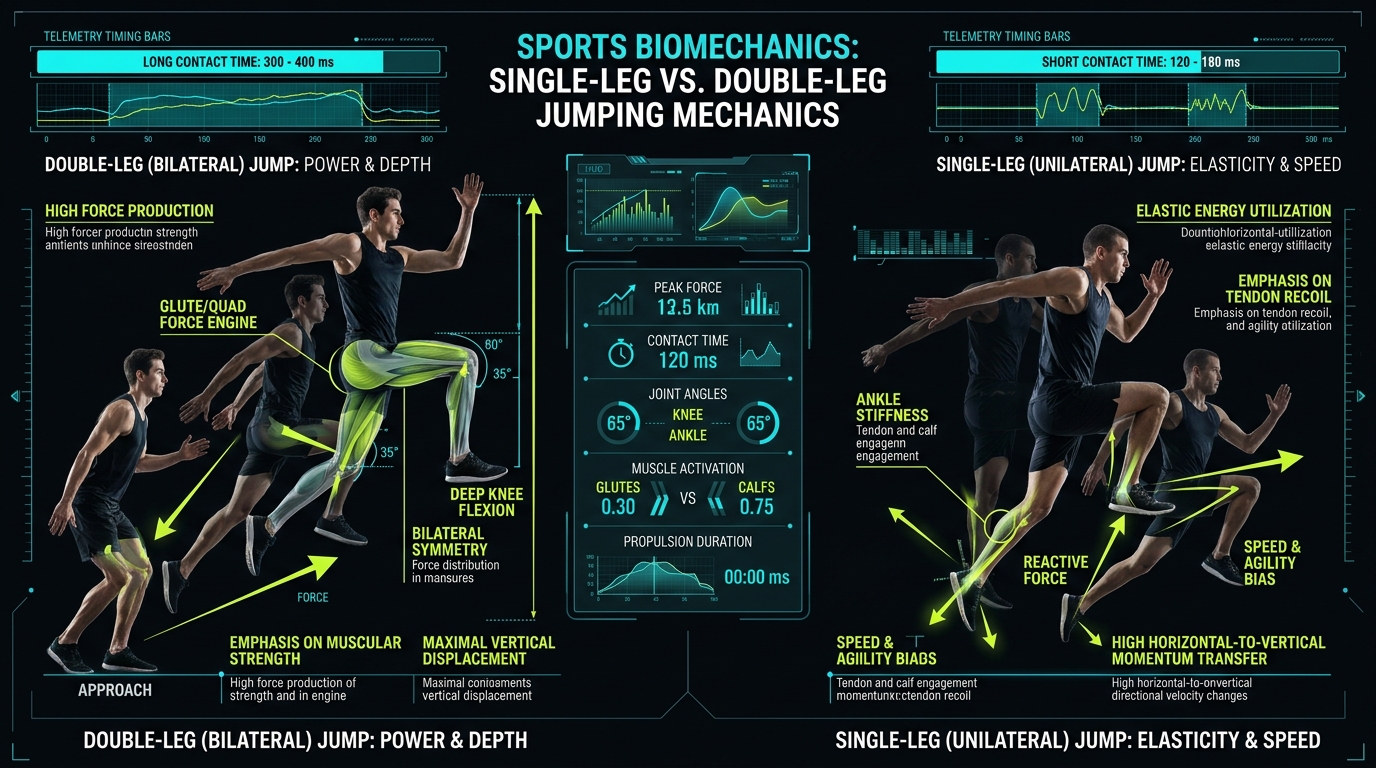
Double-leg jumps (CMJ-type) use symmetric force and the full SSC with a longer contact of 300–500 ms — ideal for standing jumps under the rim. Single-leg jumps (RJ-type) use asymmetric force and horizontal-to-vertical conversion with a shorter 150–250 ms contact, relying more on the Achilles and arch.
Why train both
Build the double-leg strength base with squats and CMJs, then add single-leg specificity with Bulgarian split squats and single-leg bounds. Two-leg height and one-leg height correlate but do not equal each other.
Use the gap as a diagnostic
Compare your CMJ with your approach reach. A large gap between them shows which direction is your weak link and where the next training block should point.
What each jump demands
Double-leg jumps produce symmetric force through a longer contact (300–500 ms) and use the full stretch-shortening cycle — the quality behind standing verticals. Single-leg running takeoffs use a shorter contact (150–250 ms), more Achilles and arch contribution, and depend on converting horizontal momentum into vertical height.
How to test the gap
Test CMJ and approach reach (or a single-leg jump) in the same session with the same warm-up. If the approach is much better, the double-leg strength base needs work; if the standing jump is better, conversion and single-leg mechanics are the target.
Re-test monthly and let the gap, not the feeling, choose the emphasis.
A balanced training plan
Most athletes need both qualities, in this order:
- Double-leg strength base: squats, CMJs.
- Single-leg specificity: Bulgarian split squats, single-leg bounds.
- Conversion: approach jumps, short sprints.
- Re-test: CMJ and approach reach monthly.
Key takeaways
- Double-leg jumps build symmetric SSC force; single-leg builds conversion.
- Train the strength base double-leg, add single-leg specificity.
- The CMJ-to-approach gap tells you what to prioritize.
- Two-leg height and one-leg height are related but not interchangeable.
- Use the CMJ-to-approach gap to choose the next block's emphasis.
Related calculators
References
- Verkhoshansky & Siff (2009) Supertraining, Ch. 6
- Bobbert et al. (1987) Int J Sports Med
- PubMed: Single-leg and double-leg vertical jump performance
Keep reading
TECHNIQUE
Arm Swing in the Vertical Jump: How Much Does It Matter?
The arm swing contributes 10–15% of jump height. Here is how it works mechanically and how to time it correctly.
TECHNIQUE
How Deep Should the Countermovement Be in a CMJ?
Deeper is not better. Research points to a natural, fluid dip around 90–100° of knee flexion — and speed matters more than depth.
TECHNIQUE
Approach Jump Technique: The Three Cues That Matter
Penultimate step, block step and takeoff — the three phases that turn horizontal speed into vertical height, with the common approach-jump mistakes that kill distance and how to fix them.
Related exercises
Single Leg Bound
Take off on one leg, leap as far and high as possible, land on the same leg and immediately bound again
Single Leg Box Jump
Highly specific single-leg jump training — trains single-leg takeoff, stable box landings and left/right power differences; suits basketball layups, volleyball approach jumps and more
Lateral Bound
Fills the blind spot of jump training — lateral bounds develop frontal-plane power, overall lower-limb function and hip stability, preventing common jump injuries
Standing Broad Jump
The most natural horizontal power test — it directly reflects lower-body drive and correlates highly with vertical jump height