Arm Swing in the Vertical Jump: How Much Does It Matter?
The arm swing contributes 10–15% of jump height. Here is how it works mechanically and how to time it correctly.
On a 60 cm countermovement jump, the arm swing is worth roughly 6–9 cm. That is the difference between a good jump and a great one — and it is almost entirely technique.
The arm swing is not a stylistic extra — it is a mechanical contribution of 10–15% of jump height, driven by momentum transfer and joint torques that you can train and time.
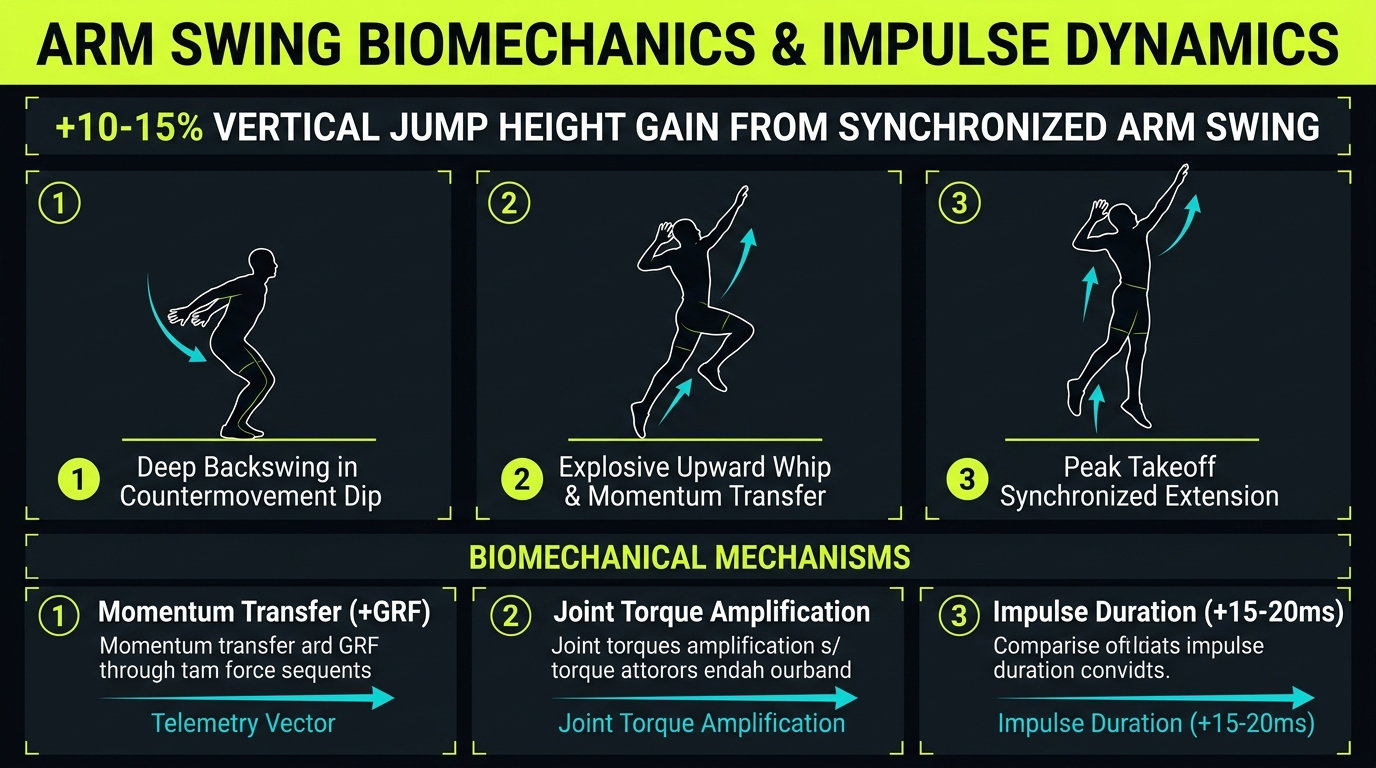
Three mechanisms
The arms help in three ways:
- Momentum transfer: swinging the arms up transfers momentum to the body and increases ground reaction force.
- Shoulder torque: the reaction torque of accelerating the arms assists hip-knee extension.
- Timing: the swing lengthens force application by ~15–20 ms, increasing impulse (force × time).
Correct timing
Start with the arms swung fully back, continue them back through the dip, then on the drive whip them forward and up at maximum speed, fingertips reaching toward the sky. The arm drive and leg extension should finish together.
Common errors
The two classic faults are timing and direction:
- Swinging too early or too late — the arms must peak as the legs extend.
- Swinging forward instead of up — forward motion leaks force.
Drills
Overhead med-ball throws build the same fast upward drive, weighted pull-ups strengthen the muscles that accelerate the arms down into the swing, and video analysis is the fastest way to catch timing errors.
The mechanism in detail
The classic studies put the arm swing's contribution at 10–15% of jump height. Three mechanisms produce it: upward arm momentum transfers to the whole body and increases ground reaction force; the reaction torque of arm acceleration assists hip and knee extension; and the swing lengthens force application by roughly 15–20 ms, increasing impulse.
How to coach the swing
Teach it as one sequence: arms swing back through the dip, then whip forward and up at maximum speed, fingertips toward the sky, finishing exactly as the legs complete extension.
The most common faults are timing (arms peak too early or late) and direction (swinging forward instead of up). Both are visible on a side-view video.
Drills and feedback
A short toolbox for improving the swing:
- Overhead med-ball throws to train fast upward drive.
- Weighted pull-ups to strengthen the muscles that accelerate the arms.
- Jump with arms vs arms restrained to feel the contribution.
- Side-view video review — catch timing errors before they become habits.
- Cue 'throw the hands' on the takeoff.
Key takeaways
- The arm swing is worth 10–15% of jump height.
- Whip the arms forward and up at maximum speed, finishing with leg extension.
- Record yourself: too-early, too-late or forward swings are the common faults.
- Train the swing like a skill: video it and fix timing.
- The swing adds ~6–9 cm on a 60 cm jump — worth more than most training variables.
Related calculators
References
- Harman et al. (1990) Med Sci Sports Exerc
- Lees et al. (2004) J Strength Cond Res
- Feltner et al. (1999) J Biomech
- PubMed: Arm swing and vertical jump height
Keep reading
TECHNIQUE
How Deep Should the Countermovement Be in a CMJ?
Deeper is not better. Research points to a natural, fluid dip around 90–100° of knee flexion — and speed matters more than depth.
TECHNIQUE
Approach Jump Technique: The Three Cues That Matter
Penultimate step, block step and takeoff — the three phases that turn horizontal speed into vertical height, with the common approach-jump mistakes that kill distance and how to fix them.
TECHNIQUE
Single-Leg vs Double-Leg Jumps: Which Should You Train?
Two-leg jumps build symmetric force; one-leg jumps build horizontal-to-vertical conversion. Most athletes need both.
Related exercises
Medicine Ball Overhead Throw
Mimics the jump arm-swing pattern — overhead med-ball throws train upper-body power and whole-body coordination; the upward arm action matches the jump swing exactly
Weighted Pull Up
Pull-ups with added weight around the waist
Medicine Ball Slam
Complements the arm swing — slams train coordinated lats-and-core explosiveness, strengthening the arm's extension-to-flexion power pattern