BounceLab vs My Jump, Vert Shock and JumpKit: How to Choose
A practical comparison of assessment-first training with BounceLab, measurement apps like My Jump, fixed programs like Vert Shock, and jump-testing hardware like JumpKit.
Most vertical jump tools fit one of four jobs: measure, prescribe, coach, or motivate. The right choice depends on which link in that chain you are missing.
This guide compares BounceLab against the tools athletes most often ask about, using the same questions for each: what it measures, what it changes, and where it fits in your training loop.
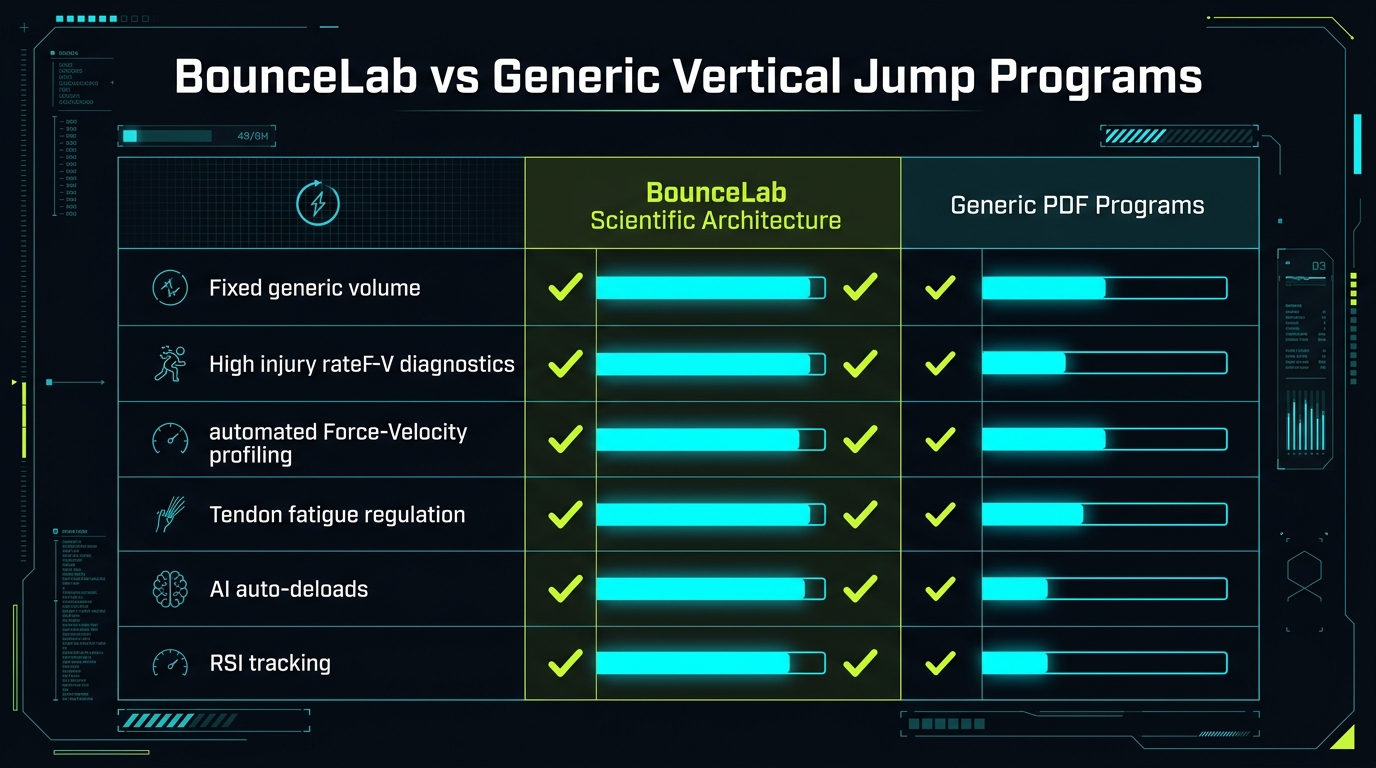
BounceLab: assessment first, then a plan
BounceLab starts with a standardized assessment (Basic, Standard or Advanced), scores your readiness, flags injury risk, and uses that profile to generate a personal training plan. The loop is diagnosis → prescription → re-test, with progress tracking built in.
My Jump / My Jump Lab
My Jump-style apps turn phone video or flight time into jump height. They are strong measurement tools and useful for weekly CMJ tracking. They do not diagnose why the jump is where it is or build a phase plan — that measurement is an input, not a training system.
Vert Shock
Vert Shock is a fixed jump program with a known sequence and community following. If you respond well to a predetermined schedule, it is simple to follow. The limitation of any fixed program is that it cannot adapt to your strength level, injury history, equipment or current bottleneck — two athletes with the same height may need opposite work.
JumpKit and contact mats
JumpKit-style contact mats and flight-time hardware add objective RSI and contact-time measurement. That data pairs naturally with an assessment layer: the hardware answers 'what happened', while a diagnostic layer answers 'why and what next'.
How to choose
Use this decision order rather than buying another program first:
- No baseline data → measure CMJ, approach jump and broad jump first.
- Baseline measured but no plan → use BounceLab assessment and plan generation.
- Need weekly precision → add a My Jump-style app or contact mat for tracking.
- Want a simple fixed block → try a fixed program, but re-test and change it if the bottleneck is not addressed.
- Returning from injury → prioritize assessment, load management and professional clearance.
A practical stack
Many athletes get the best result from combining tools rather than choosing one: use a measurement app or mat for testing, BounceLab for diagnosis and periodized prescription, and a fixed program only as a temporary training block if it matches the diagnosed bottleneck.
Key takeaways
- Measurement tools say what changed; diagnostic tools say what to train next.
- BounceLab covers diagnosis, plan generation and re-testing in one loop.
- Fixed programs work best when the athlete already matches their assumptions.
- A contact mat or phone app improves the precision of any training plan.
- The best stack often combines measurement + assessment rather than choosing one product.
Related calculators
References
Keep reading
TRAINING PROGRESS
How Long Until You See Results From Jump Training?
A realistic vertical jump improvement timeline: what changes at 2, 4, 8 and 12 weeks, and why starting level, training quality and recovery decide the pace.
TRAINING METHODS
How Many Jump Training Sessions Per Week Do You Actually Need?
Training frequency by experience level, safe plyometric contact volume, and the warning signs that tell you to cut back.
TRAINING PROGRESS
How to Break a Jump Training Plateau
A plateau means the body has adapted to the current stimulus. Diagnose the weak link, change the variables, deload and fix recovery.
Related exercises
Countermovement Jump (CMJ)
The standard vertical jump — from standing, dip into a quick countermovement and immediately jump as high as possible with a full arm swing
Box Jump
The first-choice entry to plyometrics — the box jump teaches fast force production and coordinated landing, a cornerstone of jump training
Standing Broad Jump
The most natural horizontal power test — it directly reflects lower-body drive and correlates highly with vertical jump height