TRAINING GUIDE
8-Week Vertical Jump Program: A Step-by-Step Training Plan
A ready-to-run 8-week vertical jump program in three phases: build the strength base, convert it into power, then peak your explosiveness — with weekly schedules, progression rules and re-test points.
This is a complete, ready-to-run 8-week vertical jump program. It follows an order the evidence consistently supports: build a strength base first, convert that strength into power, then peak your explosive output and re-test on a fixed schedule.
This program is a starting point — not a substitute for a diagnosis. BounceLab's free assessment measures your strength, explosiveness, mobility and injury-risk profile separately, then generates a plan built around your specific weak link. Run that assessment before you start, and again at the end, so you know whether your training moved the number that actually limits you.
Follow the re-test protocol and the progression rules exactly. If anything hurts beyond normal soreness, drop the load and read the safety boundaries before continuing.
Who this program is for (and the prerequisites)
This 8-week block suits athletes who can squat roughly 1.0–1.5x bodyweight, have no acute lower-limb injury, and can commit to 3 training sessions per week. If your squat is well below 1.0x bodyweight, spend 4–6 weeks on strength-first work before this block, because plyometric gains are capped by your strength base.
Before you begin: complete the BounceLab assessment to flag injuries, mobility limits or load-management risks. Do not start this program with unresolved patellar, Achilles or ankle pain — resolve those first with the rehab guidance.
Program overview: three phases, eight weeks
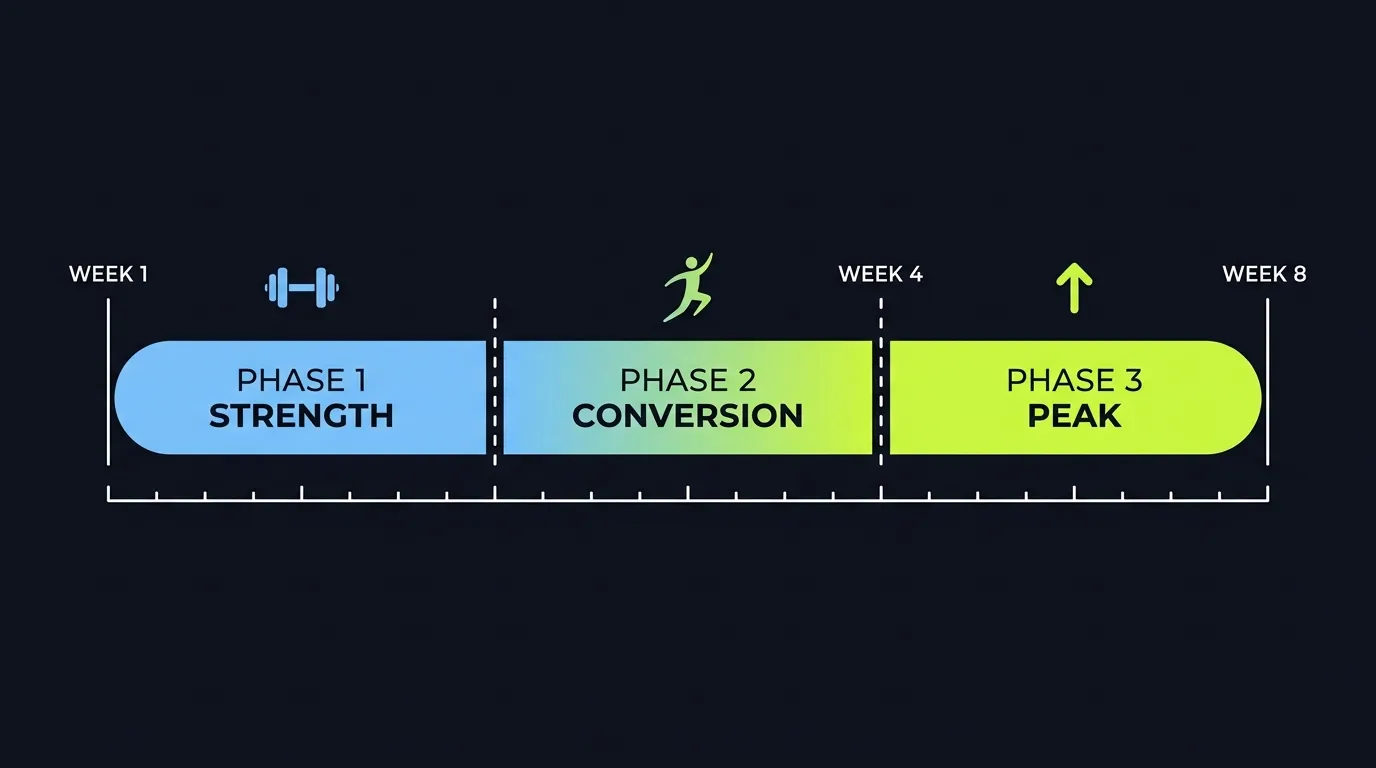
The block is split into three phases, each with a clear job. The weekly schedule keeps the same shape every week so adherence is easy; only the emphasis changes.
- Phase 1 (Weeks 1–3) — Strength base: heavier squats, hip-hinge and single-leg work, low plyometric volume.
- Phase 2 (Weeks 4–6) — Conversion: strength-to-power transfer with jumps, throws and faster lifting.
- Phase 3 (Weeks 7–8) — Peak: lower volume, higher intent, maximal jump and sprint quality, then a re-test.
- Week 5 includes a mini-deload so you arrive at the peak phase fresh.
Weekly schedule template (3 sessions)
Run three sessions per week with at least one rest day between sessions. A sample split that keeps heavy lifting and jumping separated:
- Session A — Strength: squat pattern + hip hinge + single-leg accessory.
- Session B — Explosive: light strength + jump/power work (low volume, high intent).
- Session C — Strength + technique: second squat pattern + plyometric technique + core.
- Optional: 1–2 easy aerobic or walk sessions on off days to support recovery, not fatigue.
Phase 1 — Build the strength base (Weeks 1–3)
Most jump programs fail because they jump too early. In weeks 1–3 you accumulate strength with controlled volume so the later explosive work has a base to convert.
Squat pattern: 3–4 sets x 4–6 reps at roughly 75–85% of 1RM. Hip hinge (deadlift or trap-bar deadlift): 3 x 5–8. Single-leg (split squat or lunge): 3 x 8/leg. Jump volume: keep to 20–40 low-intensity foot contacts per session — pogo jumps and small box jumps only.
Phase 2 — Convert strength into power (Weeks 4–6)
Now the strength you built gets expressed quickly. The same movements move faster and lighter, and jump intensity rises while sets stay short to protect quality.
Squat pattern: 3–4 sets x 3–5 reps at 70–80% with deliberate bar speed. Add a ballistic lift such as jump squats or trap-bar jumps: 3–4 x 3–5 with full rest. Plyometric volume steps up to 60–80 contacts including depth drops and depth jumps from a low box, always with short ground contact and a straight-up rebound.
Phase 3 — Peak explosiveness (Weeks 7–8)
Volume drops, intent goes maximal. Each rep is treated as a competition attempt. Fatigue is managed tightly so you test at your best.
Strength: 3 x 3 at 75–82% with maximum bar speed, or a light-speed day at 60–70%. Power: maximal jumps and sprints, 3–5 total high-effort sets, 3+ minutes rest. Jumps include maximal CMJ, broad jump and approach jump for your sport. Total weekly contacts drop to roughly 40–60 so quality stays high.
Progression rules
Add load only when bar speed stays high and technique stays clean. As a guide:
- Strength moves: add 2.5–5% to the bar only after the top set moves fast for two consecutive sessions.
- Plyometrics: advance box height or jump distance only when the current height produces short, sharp contacts without losing rebound height.
- Mini-deload in week 5: cut volume by about half, keep intensity the same, skip jumps for that week.
- Re-test every 2 weeks with the same CMJ protocol; changes under roughly 1–2 cm are noise.
How to measure progress
Test the same way every time: same venue, same shoes, same warm-up, best of three with full rest between attempts. Log CMJ, squat jump and standing broad jump at weeks 0, 4 and 8. Use BounceLab's jump tracker to keep the numbers comparable and see the trend instead of chasing single-day jumps.
Nutrition and recovery notes
An 8-week block is won in the kitchen and the bedroom as much as the gym. Hit roughly 1.6–2.0 g/kg of protein daily, spread across meals, and prioritize 7+ hours of sleep — jump performance drops measurably below that. If a cut is needed, keep the deficit small (under about 500 kcal/day) so power output and recovery hold up.
Key takeaways
- Assess before you start and re-test at weeks 0, 4 and 8 with the same protocol.
- Three sessions per week: strength, explosive, and strength + technique.
- Phase 1 builds strength, Phase 2 converts it to power, Phase 3 peaks it.
- Add load or box height only when bar speed and jump quality stay high.
- This generic program is a starting point — a personalized diagnosis targets your actual weak link.
References
- Sáez de Villarreal et al. (2009) J Strength Cond Res — plyometric training meta-analysis
- Verkhoshansky & Siff (2009) Supertraining, Ch. 5
- NSCA Essentials of Strength Training and Conditioning (4th ed.), Ch. 18
- ISSN Position Stand: protein intake
Related articles
How to Track Jump Progress Scientifically
One standard test, fixed conditions, weekly frequency and the smallest worthwhile change — the protocol that turns jump data into decisions.
CMJ vs Squat Jump: The Simplest Jump Bottleneck Test
The difference between your countermovement jump and squat jump reveals whether strength or elastic use is your limiting factor.
How to Split Strength and Plyometric Training
Combined strength and plyometric training beats either alone. Here are the phase ratios, same-day ordering rules and common mistakes.
How to Design a Full Jump-Training Macrocycle
The 12–16 week structure: base adaptation, max strength, power conversion, then peak and test. With RPE and volume targets for each phase.
How to Do a Deload Week (Without Losing Progress)
The three ways to deload, how often, and why performance often peaks the week after a deload — not during the hardest training.
What Should You Eat for Jump Training?
Protein, carbs, fat, timing and hydration for a 70 kg jump athlete — plus the two things to strictly avoid. How to fuel power training, pre-session and recovery with evidence-based numbers.
Which Training Gives the Most Jump Per Hour?
The ROI ranking: foundational strength first, then power conversion, depth jumps, technique — and supplements last.
Key exercises
Barbell Back Squat
The king of strength training and an irreplaceable foundation movement for jump training
Jump Squat
The most direct vertical-power entry — explode from a shallow squat, then reorganize your posture after landing
Depth Jump
The gold-standard jump exercise — the depth jump maximizes SSC (stretch-shortening cycle) use, directly raising reactive strength and jump height
Pogo Jump
The two-foot entry of the ankle-elasticity family — pogo jumps train Achilles stiffness and elastic-energy utilization
Box Jump
The first-choice entry to plyometrics — the box jump teaches fast force production and coordinated landing, a cornerstone of jump training
Trap Bar Deadlift
A high-quality strength movement for jump training — research shows trap-bar deadlifts may transfer to CMJ better than conventional deadlifts, are friendlier to the lower back, and train the front and posterior chains evenly
Standing Broad Jump
The most natural horizontal power test — it directly reflects lower-body drive and correlates highly with vertical jump height
Countermovement Jump (CMJ)
The standard vertical jump — from standing, dip into a quick countermovement and immediately jump as high as possible with a full arm swing