Achilles Tendinopathy and Rupture: Prevention Guide
The strongest tendon in the body is also heavily loaded by jumping. Here is the prevention checklist and the rupture warning signs that are an emergency.
The Achilles is the strongest tendon in the body — but jump training loads it heavily and repeatedly. Prevention is straightforward; rupture is catastrophic and partly predictable.
The Achilles tolerates huge loads but adapts slowly. Prevention is essentially volume management plus regular loading at the right intensity — the same two levers as every other tendon.
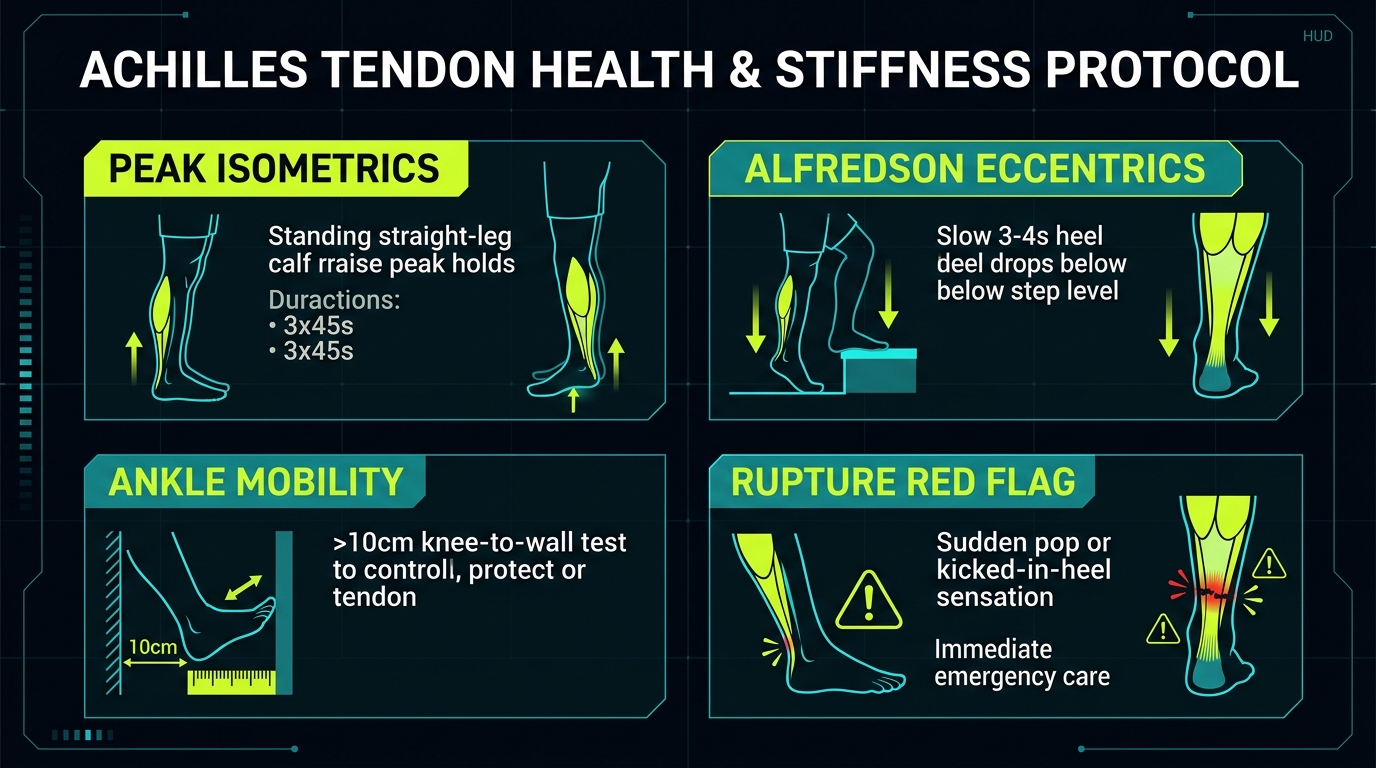
Tendinopathy prevention
Five habits that protect the Achilles:
- Progress load gradually — weekly volume no more than +10%.
- Add isometrics: calf-raise peak holds 3×45s, 3–4 times per week.
- Maintain ankle mobility — limited dorsiflexion (under 10 cm knee-to-wall) is a risk factor.
- Avoid weekend-warrior spikes in volume.
- Use eccentrics: straight- and bent-knee slow lowers with 3–4 second lowering.
Rupture warning signs
Persistent morning stiffness over 30 minutes, mid-tendon thickening with pain, or abnormal ultrasound structure all deserve assessment. A sudden 'kicked in the heel' feeling with a visible gap is a rupture — that is an emergency and requires immediate surgical evaluation.
Why eccentric loading works
The Alfredson heel-drop protocol — slow, loaded eccentric lowering — has the strongest evidence base in conservative treatment of mid-portion Achilles tendinopathy, with benefits maintained at five-year follow-up.
Recent trials also show that a combined concentric-eccentric program (Silbernagel) produces similar clinical outcomes at one year. The practical conclusion: progressive loading works, and the best program is the one you can adhere to.
A practical prevention program
A weekly tendon-maintenance template:
- Isometrics 3–4×/week: calf-raise peak holds 3×45 seconds.
- Eccentrics 2×/week: straight- and bent-knee slow lowers, 3–4 second lowering.
- Ankle mobility: knee-to-wall distance at least 10 cm.
- Volume control: no more than +10% weekly jump volume.
- Surface control: avoid large volumes on concrete.
Reactive tendon vs rupture risk
Morning stiffness that lasts more than 30 minutes, thickening at mid-tendon, and pain that persists after warm-up are warnings, not normal aging. A sudden 'kicked in the heel' sensation with a visible gap is a rupture — emergency evaluation, not stretching.
Key takeaways
- Volume jumps of ≤10% per week protect the tendon.
- Isometrics and slow eccentrics build capacity.
- Morning stiffness, thickening and pain are warnings; a sudden gap is an emergency.
- Eccentrics and isometrics both build capacity; the best program is the one you will do.
- Morning stiffness over 30 minutes is a warning sign, not normal aging.
Related calculators
References
- O'Neill et al. (2019) Am J Sports Med
- Alfredson et al. (1998) Am J Sports Med
- Maffulli et al. (2004) J Bone Joint Surg
- PubMed: Systematic review of exercise types in Achilles tendinopathy (2023)
- PubMed: 5-year follow-up of Alfredson's heel-drop programme
Keep reading
REHAB & INJURY PREVENTION
Patellar Tendinopathy (Jumper's Knee): Prevention & Rehab
The #1 injury in jump training, explained: why the tendon overloads, evidence-based prevention and the four rehab phases from isometrics to return.
REHAB & INJURY PREVENTION
Shin Splints: What to Do and How to Prevent Them
Medial tibial stress syndrome: acute management, the strength and surface fixes that prevent it, and the red flag that means see a doctor.
REHAB & INJURY PREVENTION
Returning to Training After an Ankle Sprain
Grades, timeframes and the functional return criteria that matter more than the calendar — plus the staged path back to jumping.
Related exercises
Eccentric Heel Drop
The #1 Achilles-health insurance for jumpers — eccentric heel drops (Alfredson Protocol) are the gold standard for Achilles rehab; the eccentric load stimulates tendon repair
Weighted Calf Raise
The triceps surae contributes the final push-off in jumping (about 5-10% of jump height)
Banded Ankle Distraction
A lifesaver for jumpers with limited dorsiflexion — banded distraction restores joint space and mobility, directly improving takeoff depth