Squat Jump (SJ)
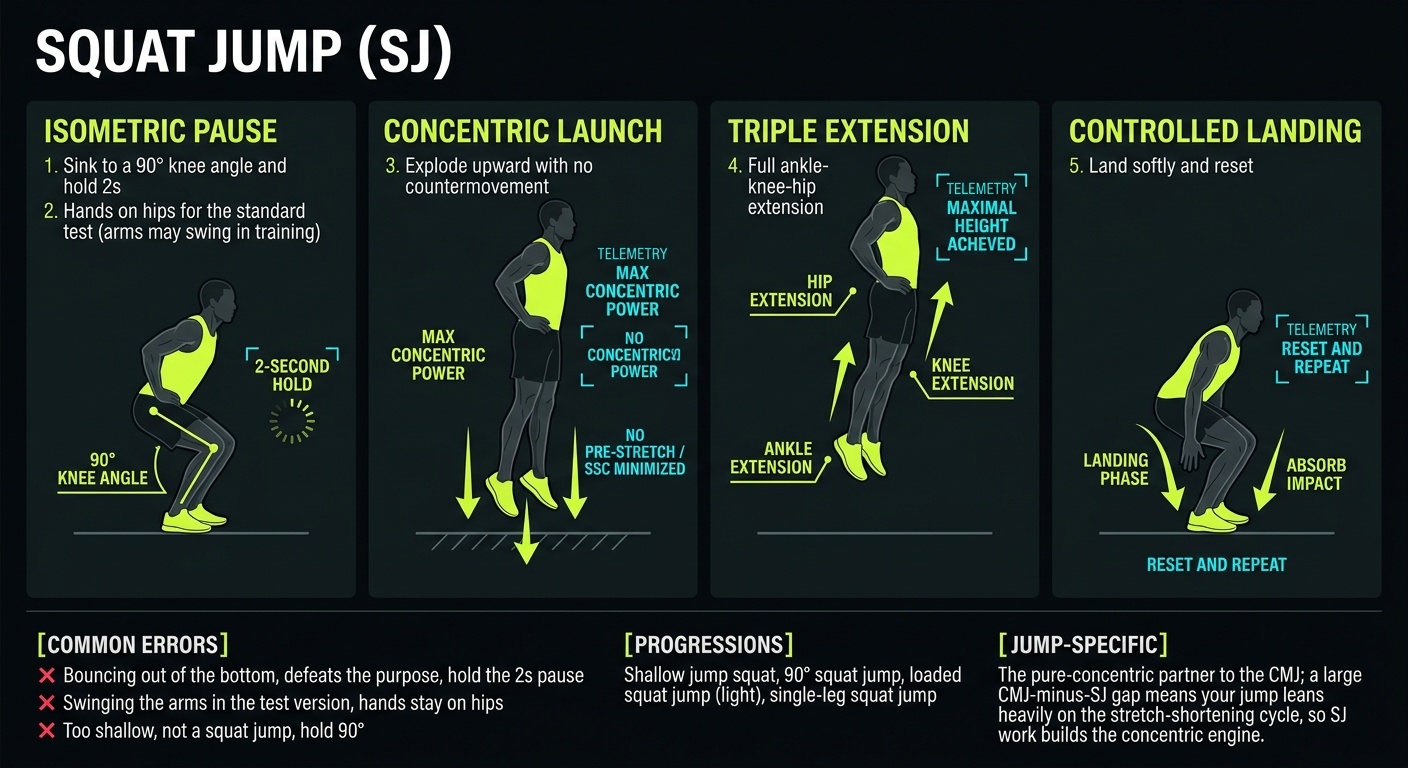
The pure-concentric jump test and training movement — hold a 90° squat for 2 seconds, then explode upward with no countermovement. Because there is no stretch-shortening cycle, the squat jump isolates concentric rate of force development (RFD), and comparing it with your CMJ reveals how much of your jump relies on the rebound.
Coaching cues
- 1.Sink to a 90° knee angle and hold 2s — no bounce
- 2.Hands on hips for the standard test; arms may swing in the training version
- 3.Explode through full ankle-knee-hip extension
- 4.Land softly, reset, and pause before the next rep
Detailed training method
Skip if deep squatting provokes knee pain; regress to a shallow jump squat if you can't hold the 90° position
Related exercises
Box Jump
The first-choice entry to plyometrics — the box jump teaches fast force production and coordinated landing, a cornerstone of jump training
Depth Drop
The preparatory exercise for depth jumps — the depth drop teaches safe, efficient absorption of landing impact (eccentric strength), laying the safety foundation for explosive rebounds
Single-Leg Landing Control
The safety prerequisite for every single-leg jump — step off a low box or hop forward, land on one leg, and stick the landing for 2 seconds