Exercise Library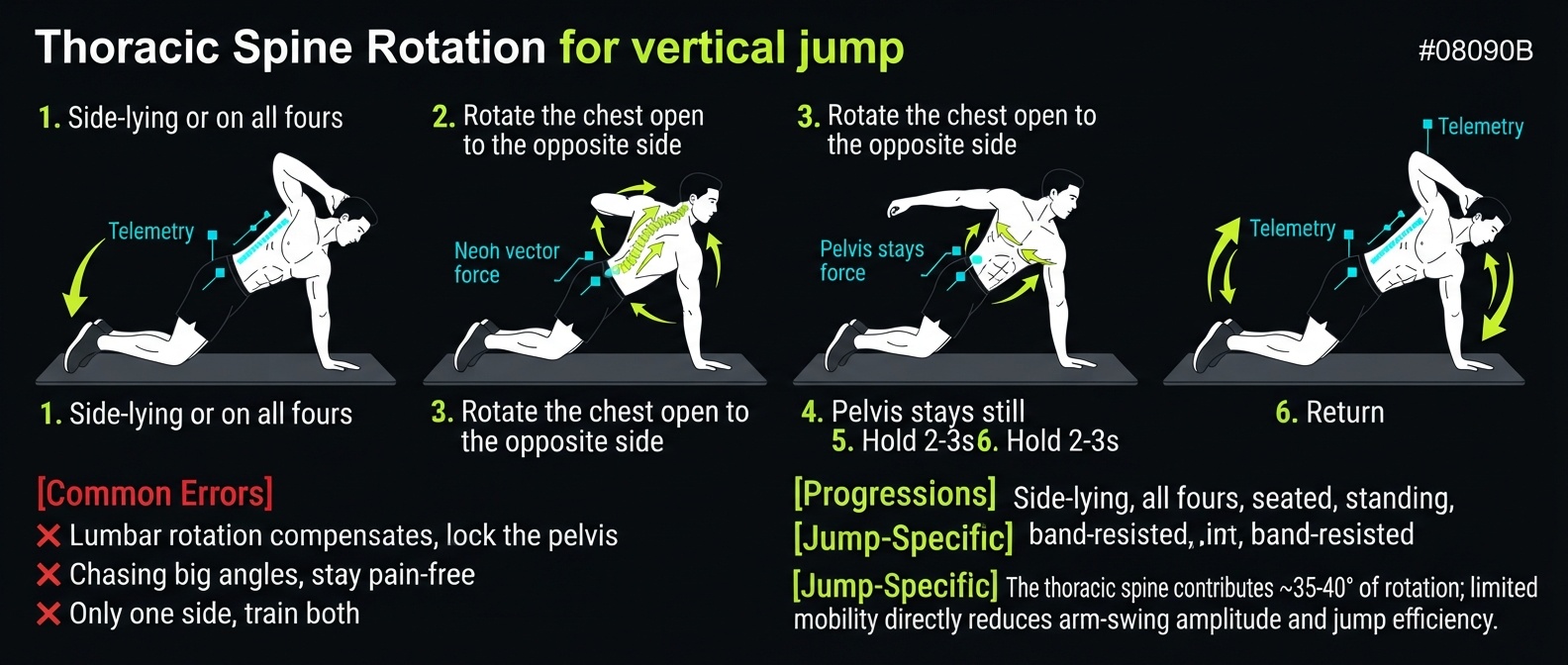
MOBILITY & FLEXIBILITYbeginner
Thoracic Spine Rotation
Unlock arm-swing potential — thoracic rotation directly affects swing amplitude and jump efficiency (the thoracic spine should contribute ~35-40° of rotation). Side-lying or quadruped, place a hand behind the head and rotate the chest open.
Thoracic spine, intercostals, lats8-10 reps per side
Coaching cues
- 1.Pelvis stays still — only the thoracic spine rotates
- 2.Exhale as you deepen the rotation
- 3.Hold the end range 2-3s
- 4.A 'stuck' feel means that side is restricted
Detailed training method
[Steps]1. Side-lying or on all fours→2. Hand behind the head→3. Rotate the chest open to the opposite side→4. Pelvis stays still→5. Hold 2-3s→6. Return
[Common Errors]✗ Lumbar rotation compensates→lock the pelvis ✗ Chasing big angles→stay pain-free ✗ Only one side→train both
[Progressions]Side-lying→all fours→seated→standing→band-resisted
[Jump-Specific]The thoracic spine contributes ~35-40° of rotation; limited mobility directly reduces arm-swing amplitude and jump efficiency
Related exercises
Ankle Dorsiflexion Stretch
A key limiter of takeoff depth — every 1cm of ankle dorsiflexion means a deeper takeoff angle, longer force application and higher jumps
Hip Flexor Stretch
Unlock hip-extension potential — limited hip extension is associated with reduced takeoff drive, and hip-flexor stretching can help restore it
Couch Stretch
Targets a key jumping muscle — the couch stretch focuses on the rectus femoris (the biarticular muscle that flexes the hip and extends the knee in jumping); tightness significantly lowers drive efficiency