Exercise Library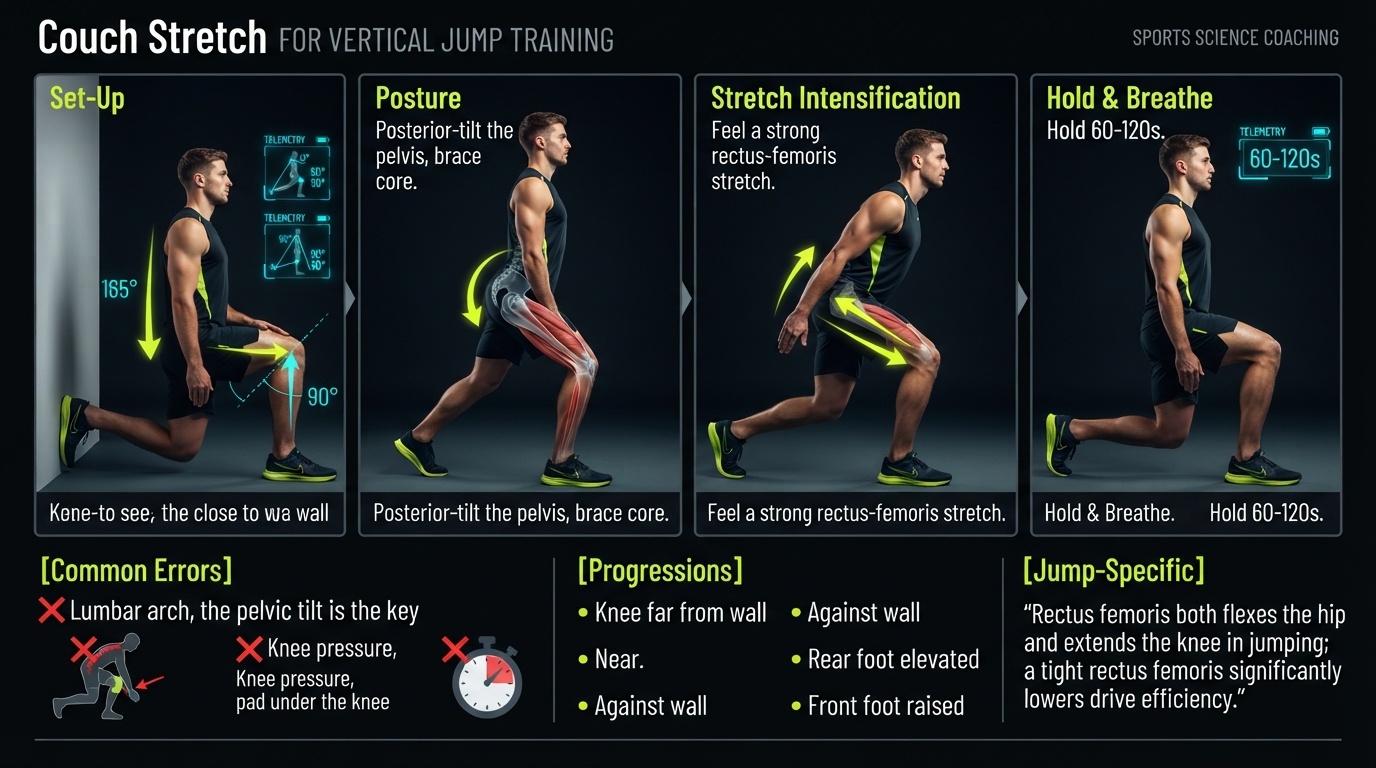
MOBILITY & FLEXIBILITYbeginner
Couch Stretch
Targets a key jumping muscle — the couch stretch focuses on the rectus femoris (the biarticular muscle that flexes the hip and extends the knee in jumping); tightness significantly lowers drive efficiency. Back knee against a wall or couch edge, front foot planted, pelvis tucked, stretch deep.
Rectus femoris, iliopsoas, distal quads2-3 × 60-120s per side
Coaching cues
- 1.Back knee as close to the wall as possible — closer = stronger
- 2.Posterior-tilt the pelvis — brace core, avoid lumbar arch
- 3.Hold 60-120s — this area needs patience
- 4.Dynamic version pre-training; static post-training
Detailed training method
[Steps]1. Back knee as close to the wall as possible→2. Front foot in a lunge→3. Posterior-tilt the pelvis, brace core→4. Feel a strong rectus-femoris stretch→5. Hold 60-120s
[Common Errors]✗ Lumbar arch→the pelvic tilt is the key ✗ Knee pressure→pad under the knee ✗ Too short→at least 60s
[Progressions]Knee far from wall→near→against wall→rear foot elevated→front foot raised
[Jump-Specific]Rectus femoris both flexes the hip and extends the knee in jumping; a tight rectus femoris significantly lowers drive efficiency
Related exercises
Ankle Dorsiflexion Stretch
A key limiter of takeoff depth — every 1cm of ankle dorsiflexion means a deeper takeoff angle, longer force application and higher jumps
Hip Flexor Stretch
Unlock hip-extension potential — limited hip extension is associated with reduced takeoff drive, and hip-flexor stretching can help restore it
Thoracic Spine Rotation
Unlock arm-swing potential — thoracic rotation directly affects swing amplitude and jump efficiency (the thoracic spine should contribute ~35-40° of rotation)