Exercise Library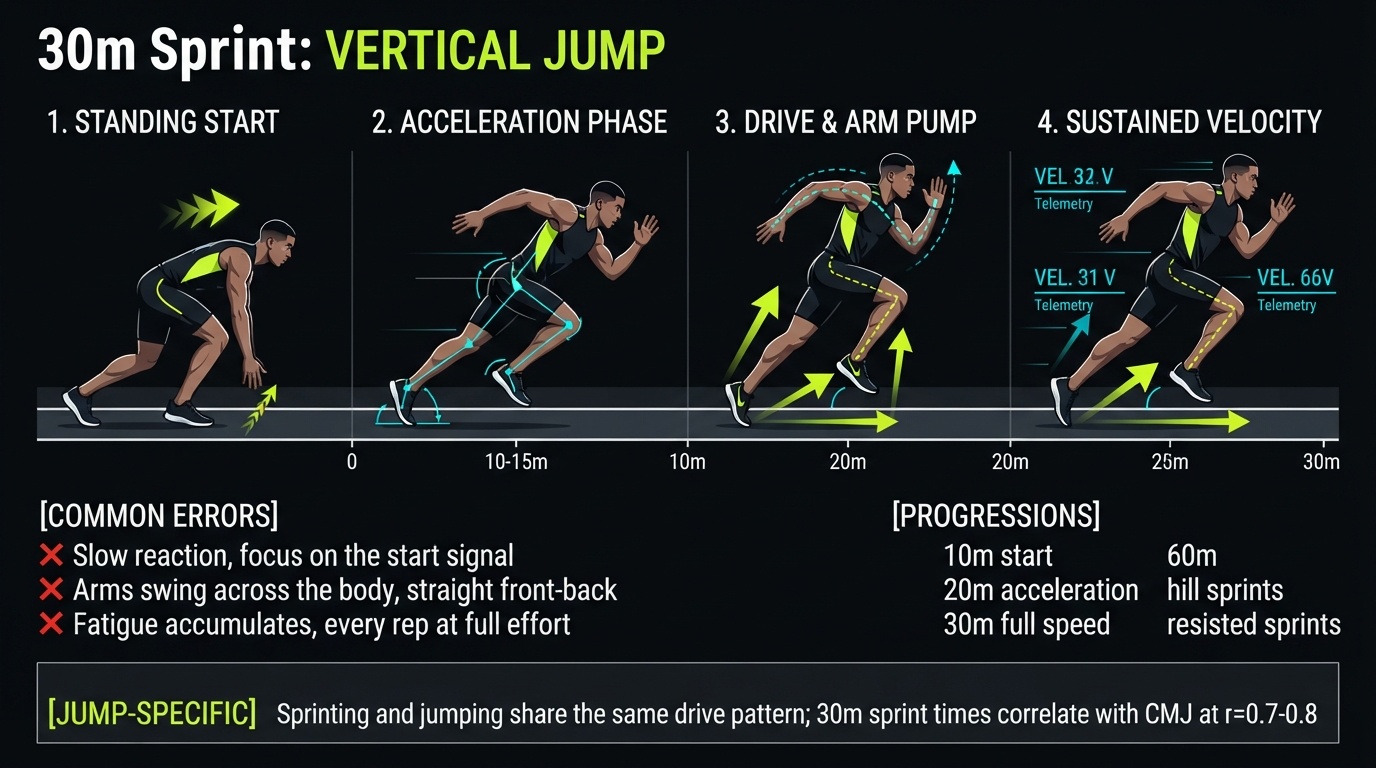
SPEED & AGILITYbeginner
30m Sprint
The twin of the jump force pattern — 30m sprints train rapid motor-unit recruitment (RFD), matching the takeoff drive. Sprint from a standing start at full effort; the first 10m develops starting power, 10-30m develops acceleration.
Glutes, hamstrings, quads, calves4-6 reps
Coaching cues
- 1.Lean forward at the start
- 2.Pump the arms fast — front swing to chin height
- 3.High knees, stiff ankles
- 4.Full rest between reps — fatigue kills quality
Detailed training method
[Steps]1. Standing start→2. Lean forward→3. Sprint 30m at full effort→4. Pump the arms fast (front swing to chin)→5. High knees, stiff ankles→6. Full rest before the next rep
[Common Errors]✗ Slow reaction→focus on the start signal ✗ Arms swing across the body→straight front-back ✗ Fatigue accumulates→every rep at full effort
[Progressions]10m start→20m acceleration→30m full speed→60m→hill sprints→resisted sprints
[Jump-Specific]Sprinting and jumping share the same drive pattern; 30m sprint times correlate with CMJ at r=0.7-0.8
Related calculators
Related exercises
Agility Ladder Drill
Make your feet faster and more precise — ladder drills improve neuromuscular efficiency, directly enhancing takeoff-point precision (like the penultimate step before a dunk)
Resisted Sprint
The ideal bridge between strength and speed — resisted sprints raise drive force without adding joint load, directly improving approach-jump acceleration
A-Skip
A core warm-up and running-form movement — A-skips build hip-flexor strength and cadence, directly helping the active knee drive of jumping