Exercise Library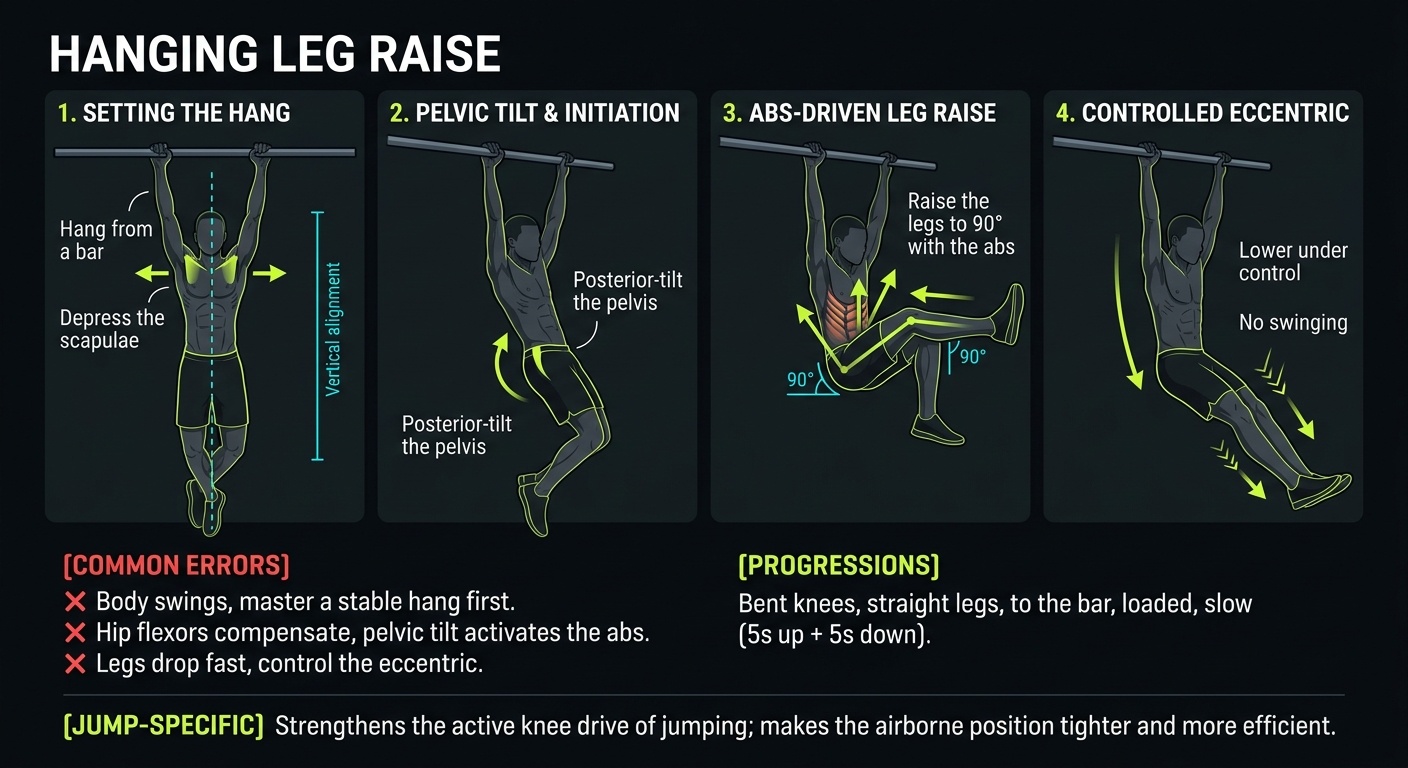
CORE STABILITY & ANTI-ROTATIONintermediate
Hanging Leg Raise
Directly strengthens the active knee-drive of jumping — hanging leg raises build the lower abs and hip flexors for a tighter, more efficient airborne position. Hang from a bar, keep the body still, and raise the legs to parallel using the abs.
Lower rectus abdominis (emphasis), hip flexors, grip3-4 sets × 10-15 reps
Coaching cues
- 1.Depress the scapulae while hanging — don't hang from the shoulders
- 2.Posterior-tilt the pelvis when raising — abs, not hip flexors
- 3.Control the lowering — no free fall
- 4.Bent knees is easier; straight legs to 90° is enough
Detailed training method
[Steps]1. Hang from a bar→2. Depress the scapulae→3. Posterior-tilt the pelvis→4. Raise the legs to 90° with the abs→5. Lower under control→6. No swinging
[Common Errors]✗ Body swings→master a stable hang first ✗ Hip flexors compensate→pelvic tilt activates the abs ✗ Legs drop fast→control the eccentric
[Progressions]Bent knees→straight legs→to the bar→loaded→slow (5s up + 5s down)
[Jump-Specific]Strengthens the active knee drive of jumping; makes the airborne position tighter and more efficient
Related exercises
Pallof Press
During jumping the core must stay stable to transfer lower-body force efficiently — the Pallof press trains anti-rotation to prevent energy leaks
Dead Bug
Protects the lower back from excessive extension during jumping — the dead bug builds core stiffness so strength training stays safe
Ab Wheel Rollout
Whole-body stiffness core training — the rollout trains anti-extension and shoulder stability so lower-body force transfers without loss